

Born on a Thursday
Old Fitz Theatre, December 2025
The review
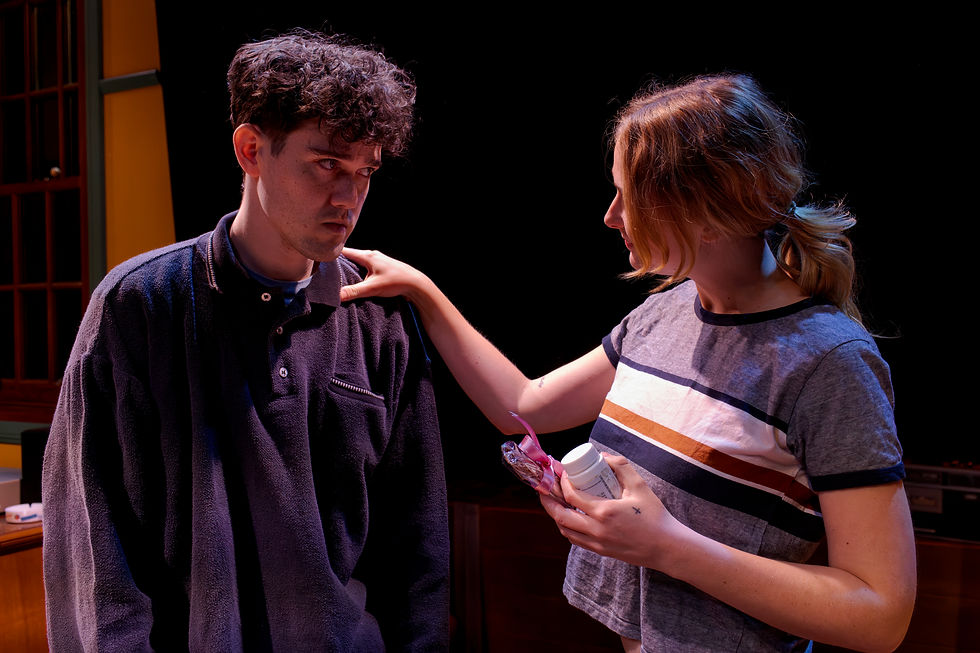
“Born on a Thursday”Till the 21st of December 2025A premiere of a new Australian play written by Jack Kearney @kackjearneyDirected by Lucy Clements @lucypodstolskiNew Ghosts Theatre Company @newghoststheatrecompany @oldfitztheatreThe work is done in consultation with the Australian Sports Brain Bank.It is set in 1990s Western Sydney, and, to what I’ve heard - I have not been here in the 90th, the stage set is made to replicate the time precisely. A dining room adjunct to the kitchen with a fridge, functioning tap, a stove, and a kettle, so sounds of bubbling oil, or boiling water, or the smell of cut onions make it deeply realistic.There is a door and windows to the back yard, semi-groomed, looking like there are some small upgrading projects going on, slowly but steadily A disk phone is mounted on the wall, and also - a paper calendar, a month-on-a-page. The space is flooded with a warm yellow light, and when it is dimmed, the coziness stays.April (Sofia Nolan), a young woman in her twenties, returns home for Christmas after being four years in Denmark without keeping contact with the family. Her appearance in the house is casual if not tense. No mother in, but only a neighbour, Howard (James Lugton). There are a couple of decorations around, but not much of a spirit to celebrate. And the tension builds up when Mum, Ingrid (Sharon Millerchip), returns from another set of appointments with her son, Issac (Owen Hasluck).It is a beautifully made piece that flawlessly unfolds itself. Where everyday conversations, small ordinary things coexist with dramas and pains which nobody calls by their names. April got back presumably for a short time, but the pages on the wall are kept turning, and she is still in. Isaac, a grown-up late-teenager, is suffering from the horrific consequences of a footy accident. Lucky to recover physically, his brain has been irreversibly damaged. Ingrid is shuffling her job at RSL, paying medical bills (April discovered by chance how expensive they are), and pushing with a questionable success but exceptionally persistent a petition out, fighting for support of victims of sports accidents.
April is getting to terms with herself, not talking much, suddenly at times lacking air to breathe.
The household is not rich - a nice directing touch - a shopping bag is full of no-frills items.
It sounds too everyday, and too everyday it is, where the roller-coaster is covered by ordinariness. There is no concept of self-care, instead there is a bubbly emotional hurricane - a friend, Estelle (Deborah Galanos). An extravagant woman, always wearing loud but quite cheap jewelry, bright clothes, not hesitating to help herself with a glass of wine from the fridge - she is excellently hilarious. There are no services to support - there is Howard, who is a modest, calm, devoted man, whose never-announced love for Ingrid is a supporting column for her.
There are no big words in this play. Nothing about novelty, loyalty, admiration - the language is richly suburban, slangy Australian, but it all is still there.
There is no psychologist involved - there is only a mother who is there and shall move on, no matter what. When April finally bursts into talking, the scene between her and Mum is not pretty. It is raw, loud, rude. Sounds familiar for any family, I guess. And there where Indrig is performing the mother’s magic. April smashes chairs and dishes, screaming, ”Can you listen to me?” and Mum replied straight back: “I am listening”. No anger back, no commentary, just a deeply intuitive feel for what to do. The same mother’s feeling of what is right bursts out when Isaac is losing the meaning, swirled into a harsh, dangerous, hysterical mood - she perfectly navigates between compassion, ordering, caring, pushing, and saving at the end.
One night, Ingrid comes back home late after a bad date, with a bleeding cut on her face, nearly fainting. Sitting on the floor on the wall holding ice, she shushes Isaac, who is wandering to the kitchen crying, “bleeding!” She tries to whisper she is ok, but then notices he freaked out, he cut his hand, and momentarily puts herself together, fixing a band-aid on him.
t is not a depressing story. It is warm and lyrical. Gently and precisely directed, and excellently acted, it gets itself not to an ending - the lives of those people are going on, but to the point where things brewing for so long are resolved. Where love and genuine care for each other - they do it, not naming it, filling the air. I cannot generalise it, but this mother, who is so socially, time-line, geographically so distant to me, shared the hope and strength to move on in something where I sometimes do lose the beacon.
Creative team
Producer Emma Wright
Set Designer Soham Apte
Costume Designer Rita Naidu
Sound Designer Sam Cheng
Lighting Designer Veronique Benett
Movement Director Shannon Burns
Dramaturg Mary Rachel Brown
Production Manager Izzy Morrissey
Stage Manager Oscar Ali
Set Builder Angus Nott
Assistant Director Jasper Reucassel
Assistant Producer Izzy Williams
Assistant Production Manager Megan Heferen
Assistant Stage Managers Sasha Byk Giroux & Justin Li
Director Observership Bella Ness
Cast
Deborah Galanos, James Lugton, Owen Hasluck, Sharon Millerchip, Sofia Nolan
Photo Credit: Phil Erbacher



Comments